No, Raphael Lemkin did not coin the term "genocide" in reference to the Great Soviet Famine
18 April 2026
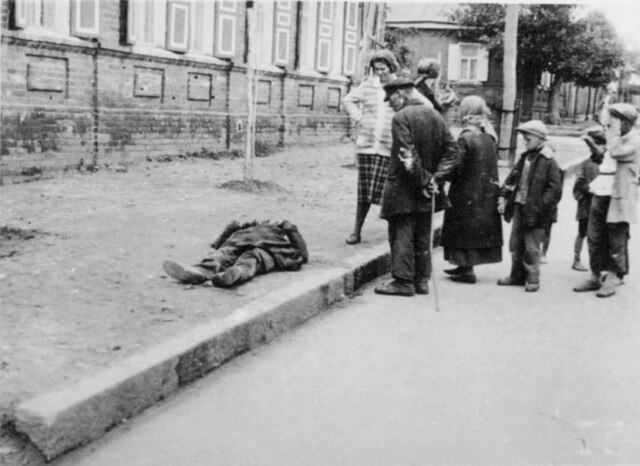
Arguing with the nationalist diaspora of the post-Soviet world is just part of being a communist loud-mouth online. Because “communism” is tantamount to Stalinism for these types, you wind up having to hash out the Great Soviet Famine in particular a good bit. I want to highlight some absurd claims made by Ukrainian nationalists and discuss the politics of “genocide” designations.
There’s a weird but re-occuring claim made by Ukrainian nationalists, especially the Ukrainian diaspora in Canada, that the term “genocide” was coined in reference to what Ukrainian nationalists refer to as “the Holodomor”, the starvation deaths which occurred in the Ukrainian SSR during the Great Soviet Famine. I’m not sure how this claim got around, but I’ve seen it more than once. The Canadian-Ukrainian and anti-communist “scholar” Maria Popova claims, for example:
The term genocide was coined by Raphael Lemkin specifically about the Holodomor and this absolute clown claims the goal of Holodomor recognition is to downgrade the Holocaust. Doesn’t get much stupider than this.
You can debunk this claim by just looking up the etymology of the word on Wiktionary, where it’s made clear that the term was coined by Lemkin between 1943 and 1944 in reference to the Holocaust, the Armenian genocide, and the ethnic cleansing of Assyrian villages by the Kingdom of Iraq. Popova, who is a Ukrainian nationalist, is ironically doing exactly what some random online Stalinists had accused her of, by obfuscating the Holocaust in the origin of the term “genocide”, in addition to just outright lying about the term’s etymology.
Lemkin did, in 1953, at the height of the Red Scare, deliver a lecture in the US where he claimed the Ukrainian starvation deaths during the Great Soviet Famine amounted to genocide, through an alleged project of the “Russification” of Ukraine. Lemkin argues:
The third prong of the Soviet plan was aimed at the farmers, the large mass of independent peasants who are the repository of the tradition, folklore and music, the national language and literature, the national spirit, of Ukraine. The weapon used against this body is perhaps the most terrible of all — starvation. Between 1932 and 1933, 5,000,000 Ukrainians starved to death, an inhumanity which the 73rd Congress decried on 28 May 1934.
Let’s first scrutinize the numbers. Davies and Wheatcroft give an estimate of deaths from starvation in the entire USSR of just over 5,000,000, with Oleh Wolowyna in 2020 estimating 8,700,000 starvation deaths in the entire USSR, with 3,900,000 in Ukraine but 3,300,000 in Russia (more than a million less than the 5,000,000 cited by Lemkin, but who’s counting?) This should be enough to demonstrate that the Ukrainians were not deliberately targeted as a nation or an ethnic group by “the Russians” – putting aside, of course, that neither Stalin nor the dastardly Kaganovich often cited for culpability in the famine were Russians themselves, that the leadership of the Soviet Union was not “Russian” but in fact multi-national.
A million deaths from starvation would be bad enough, certainly enough to discredit the Stalinist collectivization campaign and Stalinist politics in general, but does a famine amount to a genocide? Only if those in charge had “engineered” the famine deliberately with the aim of destroying the Ukrainian nation. Is there evidence for this? Not a shred, and Lemkin does not attempt to marshal any, besides references to the clergy and peasantry being carriers of Ukrainian culture (and what of the Russian peasants and clergy, who were also starved and purged?) Davies and Wheatcroft reject the idea that the famine was such a deliberate, genocidal, policy.
In our own work we, like V. P. Kozlov, have found no evidence that the Soviet authorities undertook a programme of genocide against Ukraine.
D&W are not alone in rejecting the idea of “the Holodomor”. J. Arch Getty, another eminent historian of the Soviet period, joins them:
it seems that some things do not fit the Holodomor narrative regarding Stalin’s intentions. In the special folders we find, for example, secret Stalin orders during the famine to reduce grain exports, to reduce grain exactions or to return seed grain to villages.
Getty is here explaining how newly unsealed documents from the Stalin era demonstrate secret attempts to provide famine relief in Ukraine. These attempts were kept secret in order to prevent segments of the party from reversing course on collectivization:
Presumably Stalin judged these things to be ultra-secret so as not to disturb his party face: there must be no let up. To hesitate could spark a widespread retreat. If some provinces found out that he was helping others, the image of an implacable policy would be weakened. We can suspect from some recent research that such palliative measures were too little too late but even so they would appear to be counterproductive to an intentional genocide.
Importantly, this contrasts directly with specific claims made by Lemkin and the Ukrainian nationalists who lean on his arguments, for example, that Stalin deliberately exported grain from famine afflicted areas in order to cause starvation. In actual fact, relief efforts were continuously made at great expense, both in terms of resources and in terms of political credibility and reputation. Lemkin did not have access to the above referenced documents, but modern-day petty bourgeois nationalists like Maria Popova should know better. Today’s Ukrainian nationalists have falsified history in the service of national myth-making.
Getty also explains that the word “Holodomor”, in fact, does not appear until the 1970s, when the idea began to be pushed by Ukrainian diaspora in order to buttress nationalist sentiment and to whitewash Ukrainian nationalist collaboration with the nazi invaders:
Holodomor (to kill by starvation), a term coined in the 1970s by the Ukrainian diaspora, has come into wide currency. Were it not for a new Ukrainian state with a resurgent nationalism in search of a useable past, the claims of a Ukrainian genocide intentionally perpetrated by Stalin might not be quite so pressing today. There is a new Ukrainian Institute of National Memory to sanitise wartime collaboration and focus national enmity on Russia, and scholars who have rejected the idea of intentional Holodomor risk accusations of being ‘Holodomor-deniers’ or worse.
Finally, it’s worth mentioning Lemkin’s own political affiliations. Lemkin was a supporter of the settler-colonial project of zionism in Palestine, which has itself culminated in a genocidal project, including that of deliberate starvation and engineered famine in Gaza. Even in Lemkin’s lifetime, the genocidal aims of zionism were apparent by 1948, when the Nakba resulted in the ethnic cleansing of Palestinians and the takeover of Palestinian villages by zionist settlers. Did the father of genocide studies have anything to say about zionism? Not a word, in fact. The modern day Ukrainian state is also a major supporter of the zionist project, shipping arms to Israel while the zionist occupiers bomb their neighbors and starve the Palestinians in Gaza. Maybe that’s just a coinidence.
Lemkin’s silence on zionist atrocities speaks to the political nature of “genocide” designations. Ed Herman and David Peterson’s book the Politics of Genocide describes how the word has been used to justify imperialist military interventions. That Lemkin, at the height of the Red Scare, deemed the Great Soviet Famine “genocidal”, but not the Nakba, suggests that the term has never been free from this sort of politics, that accusations of genocide have always been a part of the myth-making of nation-states which aim to militarily dominate one another. We can even see this in Russia’s own propaganda to justify its invasion of Ukraine, arguing that the Ukrainian state’s language and cultural policies were tantamount to a genocide of ethnic Russians in Crimea and the Donbass regions (to say nothing of the extensive bombing campaigns carried out by the Ukrainian state against the secessionist Donbass regions, which had reached new heights just prior to the invasion, and which had claimed the lives of thousands of civilians).
The charges of “genocide denial” in reference to the Soviet famine have become especially loud following the Russian invasion of Ukraine, as western supporters of the Ukrainian government have found it (and the Ukrainian nationalist diaspora) useful in hushing up opponents of western participation in the war and western critics of the Ukrainian government. What had been a foible of Ukrainian nationalists has now become a part of western political mythology, especially as western liberals have come to identify with the Ukrainian government as an adversary to the Russian one which they blame for the election victories of their opponents, such as Trump, Fico, and Orban, and, in the US, for the dismissal of the Democratic party by movements to the party’s left.
But it isn’t “genocide denial” to note that there is no scholarly consensus that the Great Soviet Famine was genocidal in nature, that there is no evidence of a deliberate policy of the destruction of the Ukrainian nation or people by the Communist Party under Stalin’s leadership, or that the “Holodomor” narrative is part of the post-Soviet Ukrainian government’s own nation-state building mythology, in particular its whitewashing of Ukrainian nationalist participation in the Holocaust during nazi occupation. Anti-communists have a history of not only lying, but of using emotionally-laden language in order to make Stalinism, which the world owes some credit to for its defeat of German fascism, an evil that is itself on par with German fascism. While there are certainly worthwhile critiques of Stalinism from the left, these ain’t it.